www.drinasteinberg.com

Thursday, 28 January 2016

A roller-coaster of a novel - love, magic, ancient gods, and a whole lot more!

                                                     A Review of The Land of Frost 
By Milica Kostić

I believe that most readers will agree with me when I say that the first impression upon reading The Scent of Legacy, the first part of the Arkona Purpure trilogy, is best described as absolute surprise. At first, the novel seems like a love story, but somewhere in the middle it changes its course and takes a completely different direction, taking the readers on an amazing journey into the heart of Slavic mythology, in an utterly natural and vivid manner. I consider this approach to be a unique phenomenon in contemporary literature.
Drina Steinberg’s novels can most certainly be classified as epic fantasy. However, the author has managed to put a playful twist on the original genre and give a special appeal to an exciting, yet little-known topic. Ever so subtly, by letting the readers in on the secrets of Slavic mythology,she brings its magic into their lives, making it a cherished and well-loved element of their reality.Within this mythological framework, Drina Steinberg deals with the destinies of her characters, their emotional relationships, carefully illustrating what it is like to be a woman in the contemporary society.
Another important feature of this trilogy is its attention-grabbing quality. Simply put, both novels keep the readers on their toes the whole time. You will surely read them in one sitting.
After the first part of the trilogy, The Land of Frost had big shoes to fill. However, not only has itlived up to the expectations,it has surpassed them.
With the foundations set in The Scent of Legacy, the second part of the trilogy, The Land of Frost, opens with scenes set in the mythological realm.Moving further away from the traditional “women’s voice” in literature, the author writes about battle, blood, and murder in an extraordinarily vivid manner, while remaining true to herself and the main character’s feminine perspective.
Another interesting motif is that of parenthood, most readily observable in the relationship between Purpure and her daughter. Despite being aware of her great task and the fact that her daughter is of divine origin, Purpure is, above all, a woman whose main role is that of a mother and her child’s protector.
Less prominent, but still immensely powerful and deeply emotional is the parent-child relationship between gods. The humanness of this relationship, the pain, the regret, the sacrifice, and, finally, love, speak of the universality and supreme quality of emotions, making gods appear mortal and familiar in the readers’ eyes. 

The Land of Frost is a novel characterized by strong emotions, building up and leading to a truly intense and emotional ending. Apart from leaving a strong impression on the readers, the ending leaves plenty of room for a great sequel and leaves the readers craving for more.

Friday, 20 November 2015

To Mother Nature

Dear Mother Nature,
It is both sad and horrifying to know that your children are united only in their meaningless fight against you. So, dear Mother, I've been thinking – maybe, instead of giving us those unbelievable sunsets, breathtaking landscapes, the air we breathe and the life itself, you could just slap us all. Unexpectedly and right in the face. Just to remind us how small and insignificant we are compared to you. Both the rich and the poor, Christians and Muslims, healthy and sick, beautiful and ugly, smokers and non-smokers, Facebook users and Twitter users, literate and illiterate, black and white, hipsters and the normal folks.
Now, if that doesn't help us realize what we're doing both to ourselves and you, maybe then you could give us a tug on the ear, short and painful, just like my Russian teacher used to do when someone forgot to do his homework. Because our homework is way overdue. We failed to learn that no guns, oil, biological weapons, software, money, Facebook likes, or Bruce Willis can stop you. There is no bunker, fallout shelter, giant yacht, Mars, or Swiss bank account that can protect us from the impending doom we deserve.
If the slap and the tug don't make us realize how insignificant we are compared to you, Mother, then make us kneel on corn in front of you. The way teachers used to punish bad students. Because we lack education. We lack culture. We lack manners. And we're so, so filled with hate. Selfish, we live our lives thinking only about how to satisfy and save our own asses. We live for the moment, for the now, where everything revolves around us, and we never stop and think about what kind of future we are leaving for our children and their children. What we should cherish and save, if there's anything left to save at all and if there is any future we can hope for.  
If after all those punishments we don't learn how to love one another and how to love you, if we don't realize how lucky we are to have you, then just slap us silly. Slap us until we are all red and sad and sorry. Give us the beating of our lives, and not the s&m Christian Gray kind, but the real, Bruce Lee-style ass-kicking.

Love,
Drina


     ( picture : http://www.shiftfrequency.com/ )

Wednesday, 25 March 2015

Once upon a tribe

Once upon a time, far, far, seven seas and seven hills away, somewhere at the end of the world, a gaze away from the sky and a step away from the mother earth, there was a people.
They were special. They lived in peace and harmony. They lived in harmony with nature, their gods, and their beliefs. They defended themselves from others, with a wise head and a brave heart. They were simple, their soul was unsullied, their desires were clear, they cared for their families and their roots. Finally, they were a magical people, with strong faith they derived from the energy of nature. That’s why everyone saw them as different and unbeatable.
Unfortunately, life likes to remind us that no one is unbeatable. And so this people dispersed, fell apart, got estranged. From its origins, its beliefs, its gods. It has let time lay the dust of oblivion on everything that tied it to the place of its origin, making it drift away from its true blood, and by accepting a new religion, new alphabet, new history, this people got embedded into some new structures. Its people have turned their back on their primeval origins, and have been building walls to separate them from their fellow countrymen, walls that grow higher and higher every year.
This people still exists. The Slavic people, as it is called. Divided into four sides of the world, four religions. It lives embedded into some new countries, some new stories in textbooks. Rarely reminiscing its origins, most often in disputes, where each side uses its own scraps of past to prove they are the true ones, the greater ones, the original ones.
Once upon a time there was a people, the Slavic people, living in harmony, almost unbeatable. And this people still exists today, dispersed and estranged. The people who don’t recognize their fellow countrymen when they meet them, because they have different gods, different borders, different currency.
Sometimes, the four groups of Slavs resemble four beautiful girls who used to be friends when they were little, and have met again after many years. They will smile at one another, because that’s polite; after all, they used to be close. They’ll say hello, perhaps nod at one another, but still, they will check one another out, from head to toe, looking for flaws, telling themselves they are nothing alike, that they are better, more successful, more beautiful than the others. And yet, it takes so little for them to see themselves in others. They just need to look past the differences. They need to look past their clothes, that is, their economic status and politics, then makeup, that is, the faith that beautifies them. In the end, they should cast it all away and bare themselves in front of one another, showing their scars, creases, and imperfections, everything that represents their life, what they’ve gone through, hard and wonderful times, their history.
And if not even then, after they have casted away all the superficial differences and have bared themselves to the core, if they still don’t realize they are the same, they need to do only one more thing – they need to speak. 
Only one word is enough for them to instantly realize everything, to recognize themselves in others. Maybe they live in opposite sides of the world, maybe they belong to different religions, have different social status, politics, alphabet, but when they talk, combine phonemes into syllables, syllables into words, they understand. Maybe there are no Old Slavic scripts, not enough temples, idols, preserved tradition, maybe there will soon be no Slavs in history textbooks, but the Slavic language is still there. Alive and beautiful. A bit altered, but clear. Because, if you listen for just a while, you will understand a Slav, it will not matter if he’s from the south or the Baltic, a Protestant or an orthodox Christian. The language will tell you that this person, whether you like them or not, belongs to that special people who once lived united, far, seven seas and seven hills away, a gaze away from the sky, a step away from the mother earth, from the homeland, the one and only Slavic homeland. 


images retrieved from www.voenpro.ru


Sunday, 25 January 2015

He’s big and he’s bad

Old Slavic gods were usually in charge of two or three things. Ok, sometimes four. However, there was one Slavic god who had so many skills he was what you would call a Jack of all trades. He was so deeply involved in all aspects of everyday life, he was like a sort of ancient Google. His name was Veles, and since his name starts with a V, it makes sense that he is one of those guys whose name you shouldn’t say out loud (Voldemort, (Darth) Vader…).
If one had to describe Veles (or Volos) in only two words, they would probably say: he’s big and he’s bad. That is because some people saw him as the greatest among the greats, strong and dashing fellow (the son of a cow and the Slavic god Rod), determined and righteous protector, what you would call a saint; and some saw him as an old man with gray hair and long beard, with an old shepherd’s crook in his hand, the dark ruler, the tyrant, the ultimate bad guy, what you would call a devil. 
Although he had an army of followers who worshiped him and only him, there were still more people who thought of him only as Mr. Hyde, never Dr Jekyll. BUT, love him or hate him, one thing is for sure: everyone feared him. Like I said – he’s big and he’s bad.
If he was to apply for a job in the contemporary world, his CV would be longer than the list of Henry VIII’s wives and mistresses. Veles was in charge of the crops, wealth, property, trade, cattle, art, shepherds, tricks and cons, and wizards. He was all a god could be. He handled all the buying and the selling, contracts, media, music, and models. It is fun to note that his significance in making contracts of all kinds was so great, it was enough just to swear by him, and the contract was automatically valid. That’s it. No kind of ID necessary.
Since he was the god of cattle and crops, he was extremely important when it came to survival. People worshiped and venerated him, because they believed that his mood will decide if the harvest would be rich and if there would be enough cattle. That is why everyone did their best not to offend him, or, God forbid, make him mad in any way. He was also, when needed, in charge of the forests, wildlife, shepherds, and fertility.
It is interesting to note that Veles was creative, too. Apart from inspiring numerous musicians and writers, helping countless druids and wizards, he himself was a kind of a poet, a philosopher, a writer… He loved taking notes; it was almost as if he was keeping a journal. It is assumed that that is how the Book of Veles came into being. Still, so far, no one was able to prove that the book discovered in 1919 in Russia was actually written by the mighty god himself.
Now, if you take a closer look at the Slavic pantheon, Veles and Perun are the only two gods who appear in all Slavic mythologies, and it doesn’t matter if you’re Team V or Team P: the story about the two of them is more or less the same. They are in constant conflict. On one hand, Veles is always trying to defeat Perun, by kidnapping his wife, children, cattle, followers, basically everything and everyone he can get his paws on, while on the other, sooner or later, Perun always wins.
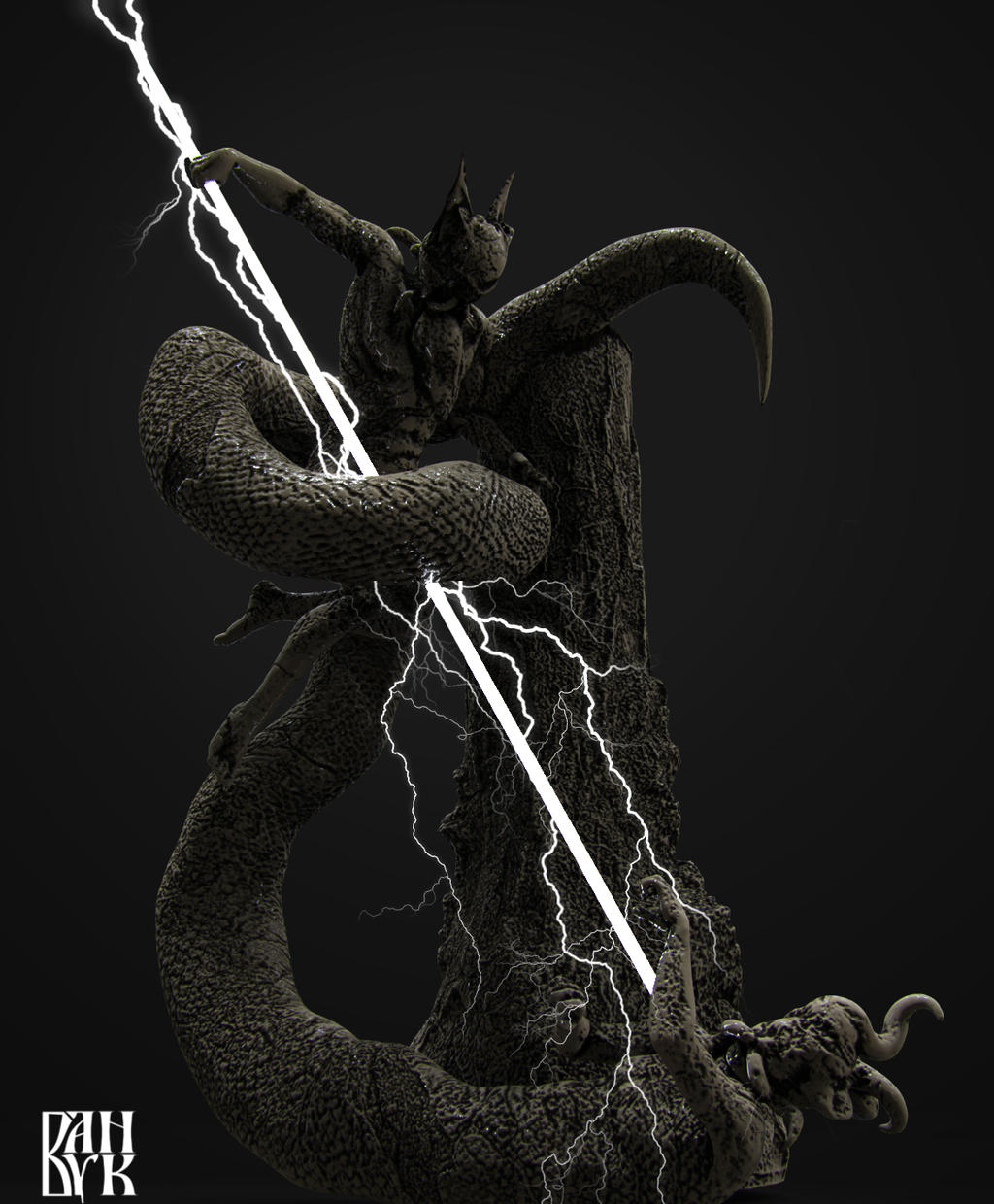
According to the most common version of the story, Veles, disguised as a snake, crawls up the World Tree, trying to reach its top. Namely, Slavs believed that the world is in fact a giant tree, with its roots representing Nav – the underworld – and its treetop representing the sky – that is, Jav.  As soon as Perun sees Veles the Snake crawling, he throws lightning bolts at him. According to the legend, once he beats Veles, Perun lets rain descend on the Earth, as a sign of victory. However, Veles always returns, so their antagonism basically represents the eternal struggle of good and evil and the universal goal of the bad guys everywhere: to become Caliph instead of the Caliph.

And finally, whether you’re one of those who see Veles, the god of beasts, as the mighty bear, the Slavic ruler of forests and nature, or you see him as the dark ruler of the underworld and the master of the dead, keep in mind: he’s big and he’s bad!

Perun vs Veles


(images retrieved from www.comicvine.com i www.kriegerman.deviantart.com)

Monday, 15 December 2014

Nothing compares to her

Once upon a time, before silicone and Botox, before Sex and the City, artificial tan, and duckface, there were women with natural looks, and more importantly, natural minds. They were beautiful, each in her own special way, with unique features that made them so different from one another. And yet, the climate of their homeland gave them certain quality they shared, which made their origin obvious at the very first sight. While a woman from Latin America, for example, would easily be recognized by her voluptuous curves, Slavic women had always been known for their uniquely simple and pure beauty. One of those beautiful, sensual women was most certainly Lada, Slavic goddess of summer, love, and beauty.
Lada, or Lado, was a gentle flower, with long golden hair, perfect, light complexion, purple eyes, and raspberry lips. With a wreath made of fresh wildflowers and birch leaves in her hair, wearing a simple, white, softly transparent dress, she brought happiness and joy to people. Her symbols were ears of wheat and the Sun, and according to astrology, her planet was Venus.  
Although her life revolved around love, feeding the hungry, and achieving world peace, she was more than just a Miss World contestant coming from Jav. Apart from being more beautiful than all Victoria’s angels put together, she was also a woman of sharp mind, righteous, patient, and dignified. Although she was aware of her qualities, she was never vain or conceited. She didn’t need an elevator in her home to help her with the troubles of high heels, because she always walked barefoot. She didn’t need a home video of the most intimate kind, because the very way she moved was more erotic than any of those. She didn’t need to put make up on her face as soon as she woke up, because she had healthy rosy cheeks. She didn’t have to frown in order to make people notice her, her lovely, sincere smile was enough. She wasn’t arrogant, although she was proud. When she loved, she loved all the way, and she wasn’t afraid of showing it. No wonder she was the one to capture the heart of the god of war, Jarilo.
Side by side, they ruled the world seven months a year. While her man strived to obey Svarog’s laws and protect the Slavs, Lada awakened the nature and preserved its fertility by giving it enough sunlight, summer rain, and warm nights. Since she was the protector of young people, love, and relationships, people often prayed to her during various rituals, asking her to protect their future marriages or mend broken hearts. Her animals were deer, rooster, and ant, and her plants were cherry, dandelion, peony, and birch. Her songs are known as Ladaricas, and one of the Christian holidays related to Lada is the Day of the Holy Trinity.
Towards the end of fall, when cold and winter begin their reign, Jarilo and Lada used to retreat to their chambers and enjoy each other’s presence. We can only guess what happened behind those doors and what pleasures were enjoyed within those walls. After all, Lada was a lady, and she never talked about intimate matters in public, not even with her best friends, over a cup of hot coffee. 
Anyway, on several occasions, at the beginning of spring, Jarilo did appear with a few extra pounds. I’m not sure what that tells us about him, but it definitely shows that, apart from other skills, Lada possessed the one that men value most – the one of cooking.


( images retrieved from www.pinterest.com)

Monday, 8 December 2014

You know you’re a Slav if:

  1. You use both Latin and Cyrillic alphabet effortlessly. 
  2. If you’re a he, you’re the most handsome of all men.
  3. If you’re a she, you are the fairest of all the ladies.
  4. Bravery level: you enter a bear cave barehanded in order to save “the damsel in distress.”
  5. Insanity level: you enter a bear cave barehanded just to prove how brave you are.
  6. You don’t want to shake off that hangover, you want to maintain it.
  7. You can be both a good guy and a bad guy in a Hollywood movie, except if you’re Russian. Then you’re definitely the bad guy.
  8. When you swear, everybody in the world understands you.
  9. When you protest against something, no one in the world understands you.
  10. You’re not afraid of getting ill, because things like that don’t happen to you.
  11. You’re the best at every single sport.
  12. You can split your country in two, and then those two new countries into four, and so on, ad infinitum et ultra.
  13. You love music more than you love bread, and you eat bread with pizza.
  14. You always fall for the Three-card Monte trick.
  15. You know many words from 13 different languages, although you’ve studied only one.
  16. Although you’re glad your neighbor is doing worse than you are, you’ll always be there for him.
  17. Every conspiracy theory involves your country.
  18. Brandy/vodka is the universal cure for all illnesses and life’s problems.
  19. You don’t agree with statement No. 12.
  20. You’re proud of your Slavic origin, although you know other people’s history better than your own.